Living in the coastal village of Bamfield, B.C., Canada, Louis Druehl is the editor of The New Bamfielder, and is best known for his passion for seaweeds. A professor of marine botany at Simon Fraser University for 36 years, Louis conducted kelp research at the Bamfield Marine Sciences Centre, which he was instrumental in establishing in 1968. His immense contributions to kelp research earned him the honour of having a diatom genus and a kelp species named after him. The revised issue (with Bridgette Clarkson) of his best-selling book Pacific Seaweeds Updated and Expanded has won numerous awards.
A Professor Emeritus from SFU, he is continuing to support kelp research as well as harvesting and exporting seaweed products globally with his wife Rae Hopkins.
Louis turned to serious, non-scientific writing after his retirement in 2000. His first novel, Cedar, Salmon and Weed, has earned a place on BC Book’s Map of Literary Fiction.
Pnina Granirer was born in Romania and immigrated to Israel in 1950. She studied at the Bezalel Art Academy in Jerusalem and came to Canada in 1965, settling in Vancouver where she has lived ever since. Her works are displayed in private and public galleries and museum collections in Canada, the US, Chile, Europe and Israel. An extensive archive of documentation on her work and life can be found in the British Columbia Artists’ Archives at the University of Victoria, BC.
Granirer has always followed her own vision, taking risks by disregarding the trends and fashions of the art world. In 1993 Granirer co-founded Artists in Our Midst, the first annual Studio Tour in Vancouver, BC. For six years she organized and hosted discussions about art via Philosopher Art Cafes sponsored by Simon Fraser University. She has been featured in several films, including Pnina Granirer: Portrait of an Artist (1989) and The Trials of Eve (1992).
In 2014 the artist was included in the encyclopedia of International Surrealism by Arturo Schwarz, Il Surrealismo—Ieri e Oggi (Italy) and in a five-page chapter of José Miguel Pérez Corrales’s Anthology, Surrealismo: El Oro del Tiempo (Spain).
A visual artist for over 60 years, Granirer has also written verse since her childhood. Garden of Words contains musings that both reflect and illuminate her paintings. The sculpted stones in the Gulf Islands, the joy of watching dancers’ bodies in movement, the shadow of a new plague, and the contemplation of being human in a complex world—all are an expression of Granirer’s wish “to plant a garden of words in [her] field of colours.”
You’re invited to visit her website: www.pninagranirer.com
Linda Dayan Frimer is an internationally recognized artist whose work addresses questions of culture, memory, trauma and reverence for the natural environment. She is a celebrated facilitator and painter who produces cultural, commemora- tive, educational and esthetically powerful contributions, and whose artworks have been described as “impactful,” “stun- ning,” “emotionally moving,” “enthralling” and “meaningful.”
Born in the wilderness town of Wells, British Columbia, from a young age Frimer was immersed in in the wonder of the forest, rivers and mountains. It was in these formative years, surrounded by the awe-inspiring natural landscape, that Frimer developed her creative vision. It was also during these early years when she first learned of war and cultural suffering. Becoming determined to champion and protect the sanctity of all life forms, Frimer turned to the creation of art as her natural medium.
Frimer’s artworks have repeatedly been called upon to represent—through fundraising, awareness and education—the work of environmental organizations, such as the Trans Canada Trail, the Raincoast Conservation Foundation and the Western Canada Wilderness Committee, who promote Canada’s vast cultural and geographic diversity, wilderness preservation and the interdependency of nature and wildlife, and spread knowledge about endangered species. Paul George, former Director of the Western Canada Wilderness Committee, has offered that perhaps equally important to the fundraising, Frimer’s work “touched upon the emotional and spiritual cords, where real change occurs.”
Alongside Frimer’s artworks championing the environment, significant collections and donations of her works have support- ed Margaret Laurence House, Canadian Red Cross, Canadian Cancer Society, Vancouver General Hospital, Richmond General Hospital, Children’s Hospital Foundation, Wells Community Hall and the Vancouver Art Gallery, among others. She is the recipient of many awards, including an Honorary Doctor of Letters from the University of the Fraser Valley. Her murals illuminate hospital walls, synagogue sanctuaries and university corridors, where it has been said they “offer healing colours that contain emotional, life enforcing light, a calming rhythmic movement and imaginative forms that are visionary.”
Frimer has facilitated cultural healing workshops between various cultural groups. She is co-founder and facilitator of the Gesher Holocaust Project, in which she developed techniques and worked with multi- generations of Holocaust survivors and their children to release trauma through art. This project resulted in the creation of powerful commemorative works of art that were exhibited throughout major cities in North America under the auspices of the Montreal Holocaust Centre.
Frimer is co-author of In Honour of Our Grandmothers: Imprints of Cultural Survival, a collaboration between two Jewish and two First Nations artists and poets that brought together research and creative exploration as a means to process trauma associated with cultural oppression and at- tempted genocide. In her book A Wilderness Journey, Frimer explores the inextricable link between her own ancestral story, her love of the wilderness and cultural resilience.
You can view more of linda’s book here.
Duane Lawrence lives in Vancouver and enjoys regular walks in beautiful Stanley Park. It was during one leisurely stroll in the park that he decided to write about the animals that live there. Recently retired, he taught high school French for 20 years in Canada and 1 year in London, and taught English in Japan for 9 years. Besides English, Duane speaks French and Japanese.
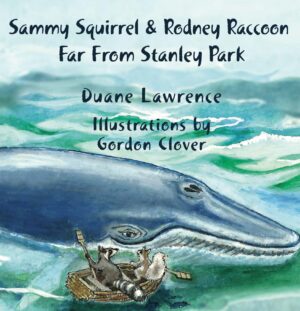
Duane has previously written 2 early chapter books for children in the primary grades. They are Sammy Squirrel & Rodney Raccoon – A Stanley Park Tale and Sammy Squirrel & Rodney Raccoon – To The Rescue. Due to popular demand, this picture book version titled Sammy Squirrel & Rodney Raccoon – Far From Stanley Park was done for preschool children who enjoy looking at illustrations and are just beginning to read.
Learn about Duane’s books at DuaneLawrence.ca
Gordon Clover was born in London, England. He taught art in both the UK and New Brunswick, where he also worked as a freelance illustrator of books and magazines. He worked at the Edmonton Journal before moving with his wife to British Columbia.
A long-time resident of North Vancouver and then Victoria, Gordon continued illustrating children’s books well into his eighties.
Dr. Brian Hayden is an author and archaeologist who has conducted research on four continents, with a passion for understanding past cultures—especially hunting and gathering societies—and the reasons for their changes. Born in New York, he obtained a Certificate of Prehistory at the University of Bordeaux, studied stone-tool making with Australian Aborigines, and earned a doctoral degree in Archaeology from the University of Toronto. For 30 years, he worked with native groups in the interior of British Columbia, recording their traditional uses of food resources and excavating the prehistoric winter village at Keatley Creek; he has also worked extensively with complex hunting and gathering societies in the region, including short fictional reconstructions of life in the prehistoric Lillooet area.
Now a Professor Emeritus of Archaeology at Simon Fraser University and Honorary Research Associate of the Anthropology Department at the University of British Columbia, Dr. Hayden lives on Cortes Island in coastal British Columbia. He has published numerous professional journal articles and books, including works on the Old Stone Age in France and a landmark synthesis of prehistoric religion (Shamans, Sorcerers, and Saints: The Prehistory of Religion, Smithsonian Publications, 2003). His later books include The Power of Feasts (Cambridge University Press, 2014) and The Power of Ritual in Prehistory: Secret Societies and the Origins of Social Complexity (Cambridge University Press, 2018). His research has been recognized by induction into the Royal Society of Canada.
You can find further information about Brian on his website.
Jan Krijff was born in the Netherlands and emigrated to Canada in 1968. He has a BA in Economics from the University of Calgary, and a master’s degree in history, from Leiden University in the Netherlands. Jan has previously published 100 Years Ago: Dutch Immigration to Manitoba in 1893; Een Aangename Vriendschap (An Amicable Friendship); Dutch Gentlemen Adventurers in Canada (with Herman Ganzevoort), and Greetings from Canada: Postcards from Dutch Immigrants to the Netherlands 1884–1915. The latter received an honourable mention for history in the Indie Fab awards.
Karen Green was born in southern Alberta. She has a BA and an LL.B from the University of Alberta, having practiced law in Edmonton and, more recently, in Vancouver where she worked in human resources and labour relations for various organizations. For twelve years, she also served as a part-time chair of review panels under the B.C. Mental Health Act. She is the co-author of Greetings from Canada and contributed to Dutch Gentlemen Adventurers.