Duane Lawrence was born in Princeton, British Columbia. He is a high-school teacher who has lived and taught in London, England and Nara, Japan (which is in a park-like setting with hundreds of tame deer). The author, who now lives in Vancouver, enjoys walking in the city s Stanley Park and on one such stroll was inspired to write about animals living there. The author speaks French and Japanese and is available for interviews and events.
Check out Duane Lawrence’s personal homepage at: duanelawrence.ca
Duane Lawrence lives in Vancouver and enjoys regular walks in beautiful Stanley Park. It was during one leisurely stroll in the park that he decided to write about the animals that live there. Recently retired, he taught high school French for 20 years in Canada and 1 year in London, and taught English in Japan for 9 years. Besides English, Duane speaks French and Japanese.
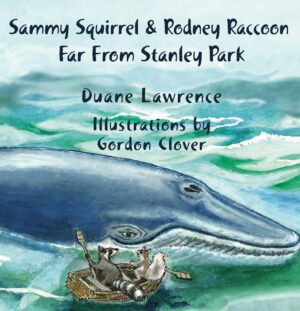
Duane has previously written 2 early chapter books for children in the primary grades. They are Sammy Squirrel & Rodney Raccoon – A Stanley Park Tale and Sammy Squirrel & Rodney Raccoon – To The Rescue. Due to popular demand, this picture book version titled Sammy Squirrel & Rodney Raccoon – Far From Stanley Park was done for preschool children who enjoy looking at illustrations and are just beginning to read.
Gordon Clover was born in London, England. He taught art in both the UK and New Brunswick, where he also worked as a freelance illustrator of books and magazines. He worked at the Edmonton Journal before moving with his wife to British Columbia.
A long-time resident of North Vancouver and then Victoria, Gordon continued illustrating children’s books well into his eighties.
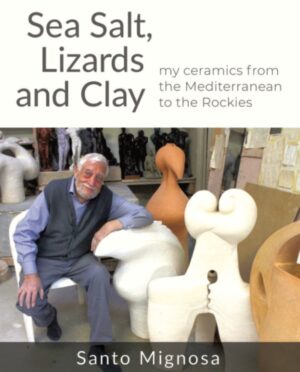
Born and raised in Sicily, Italy, Santo Mignosa studied clay in several Italian institutions after working for his father creating commercial roof tiles and bricks.
Arriving in Canada in the 1950s, Mignosa continued his studies, entered numerous national and international exhibitions and embarked upon a distinctive teaching career at the University of British Columbia’s Kootenay School of Art and at the University of Calgary. He was an active participant in national and provincial ceramic organizations and regularly presented workshops for ceramic groups and local schools.
In his mid-eighties, Mignosa continues his sculptural and drawing practice at Art in the Country in Aldergrove, British Columbia. Amid an ark of animals big and small, Santo is currently investigating the abundance of flora and fauna on a country farm that inspires and nurtures. Here he shares his life with Susan Gorris, a painter and sculptor.
Barbara McLintock is an award-winning journalist, author and broadcaster. In 2004 she was given the Victoria YM-YWCA’s Woman of Distinction Award for Communication.
She spent more than 20 years as reporter, columnist and Victoria Bureau Chief for The Province newspaper, where she won the Canadian Association of Journalists’ national award for best investigative newspaper reporting for 1996.
Her first book, Anorexia’s Fallen Angel, was named runner-up for the VanCity Book Prize.
Barbara was born in Regina, Saskatchewan, grew up in Winnipeg, Manitoba and has resided in Victoria, B.C. for the past 30 years.
This touching and exquisitely written autobiography follows a mother’s journey, framed by snapshots, through the loss of her 17-year-old son, Alex, in a freak accident, and her two late-adopted children to drugs and the streets. From this darkness, Sosnowsky learns to transform her grief into hope and, eventually, through her involvement with The Compassionate Friends — an international self-help organization of bereaved parents — to help other bereaved parents heal through her poignant poetry and compassionate listening.
Renate Thomas was born in 1953 in Germany and immigrated to Canada in 1957, where she has resided ever since. She became a Canadian citizen in 2005. Thomas has worked at tree-planting, various jobs in the lumber industry, such as manufacturing picket-fence posts and telephone poles, and on the green chain. She also drove an eighty-ton truck for a mining company.
In the midst of that busy life, she married and had two children. But the marriage did not last, and a car accident later robbed her of her eldest child. Renate picked up the pieces of her life, had a stint picking fiddlehead greens in the forests around Prince George, and later moved to Calgary. She eventually moved back to Terrace, BC and worked for the school board for ten years. Thomas now resides in the Fraser Valley city of Chilliwack, BC, the town in which she grew up.
“Life as I knew it,” she said, “ended on August 16, 1999, with the loss of my son and my personal injury.” Expressing her deepest emotions in her poetry helped Thomas recover, collect herself, and put things in perspective.
Stephen grew up in a musical family and trained as a jazz musician from a young age. Following his career as a clarinetist and chorus member in the US Air Force Band, he entered Columbia University to major in psychology and pre-med. He became a medical doctor and eventually a psychiatrist. At home and abroad, he has enjoyed playing both the clarinet and the saxophone, rubbing shoulders and sharing the stage with many extraordinary musicians. He lives in New York City.
A historical study of sports car road racing in Western Canada also documents lost race tracks, attempts to build new tracts, currently operational tracks, and amateur tracks.
Jaime Smith, MD, FRCPC was born in Appleton, Wisconsin, and upon completing his undergraduate studies in Humanities at the University of Minnesota moved to Argentina to work as an astronomer at the national observatory, leaving behind the political framework of a country that he no longer supported.
Smith’s path would ultimately lead him to British Columbia, where he was a university teacher in Physics, Mathematics and Astronomy before changing careers, receiving his M.D. followed by four years of training in psychiatry at the University of British Columbia.
Smith was a participant in the fight to de-stigmatize homosexuality within the medical community and served on the front line of the AIDS epidemic in Vancouver, BC. A widower since 2011 he has three daughters, seven grandsons and four great-grandchildren.
In his teens, Jade Bell was a handsome, popular, 6’ 3” athlete, an A-student, musician, poet and potential film-maker. Unfortunately, Jade also had a dark side. He actively indulged in alcohol and drugs. One night in 1997 when he had just turned 23, Jade went to a friend’s house where, intoxicated with alcohol, he mixed a concoction of cocaine and heroin and shot it into his arm. He collapsed and was rushed to the hospital, where he lay in a coma for two months. When he awoke he was absolutely normal at first, but then he once again slipped into unconsciousness. The next time Jade woke up, his entire body was damaged by acute muscle disorder. He could no longer speak – worse still, he was also blind. In this new, dark and desperate world, the unconditional love and inspiration of his father, Tyler Bell, taught him the true strength of the human spirit. One day something just clicked, and Jade decided he had something valuable to share with kids who face the temptation of using drugs – something that few other people still living could offer. With help from his dedicated caregivers, Jade began touring schools in Vancouver and Alberta and, more recently, in Western Quebec. He speaks to high school students – more than 100,000 over the past few years – about the horrors of drug use and the effects of an overdose. He shows a video clip, The Wrath of the Dragon, that reveals the seamy side of the Vancouver youth drug scene and talks about the wasted life waiting for those who consider or continue doing drugs. Then he plays a brief speech he created that took him two months to write. Jade says that before this tragic experience he had an “invincible, nothing-can-hurt-me” attitude as a teen. Today, many a hardened or troubled youth with that same bad attitude has broken down in tears at the sight of Jade’s uncontrollable body, beautiful blue, unseeing eyes and the power of his story. Though it’s strange to think of his plight as a “gift,” it’s one that Jade bears courageously and gracefully with a knowing smile. In 2002 he was presented with the Coast Foundation’s Courage To Come Back Award in the chemical dependency category. Jade lives independently in Vancouver, BC. In-between his school tours, Jade spends his time responding to the flood of emails from students and teachers that inevitably follow his visits. He composes poetry and song lyrics to support his campaign. His website, www.jadebell.ca, features poems, a photograph gallery and current tour news. Jade Bell is truly one of Canada’s contemporary heroes.
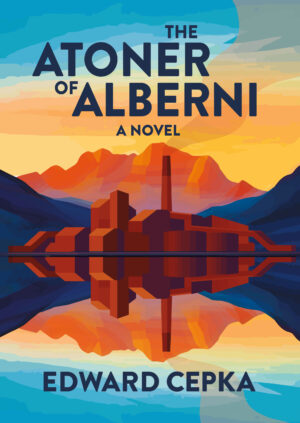
Edward Cepka grew up in Port Alberni when it was a thriving MacMillan and Bloedel company town—prosperous, industrious, and steeped in the belief that good times would last forever. Fascinated by the town’s layered history—the contrasts between working-class grit, lingering colonial wealth, and the shadow of the residential school—he began exploring its stories early on. Summers spent in the mills and forests deepened his understanding of the place. After studying English and Architecture at UBC, Cepka watched from afar as the mills closed and the town faded. What began as a pioneer saga evolved into a darkly comic meditation on colonization, environmental loss, and the ghosts of prosperity past.
Sam McBride is a native of Nelson, BC. He earned a Bachelor’s degree in English and Journalism from the University of Oregon and a Master of Communication Studies from the University of Calgary. His career includes award-winning work as a writer and communications manager in the private and public sectors in BC, Alberta and the Yukon. He serves on the advisory board of the Master of Arts in Communication and Technology program at the University of Alberta, has taught family history research and writing courses, and is the family historian for Peters, Dewdney, Gray and McBride.